Satchel Paige Comes to Duncan Park
Dr. Edwin C. Epps
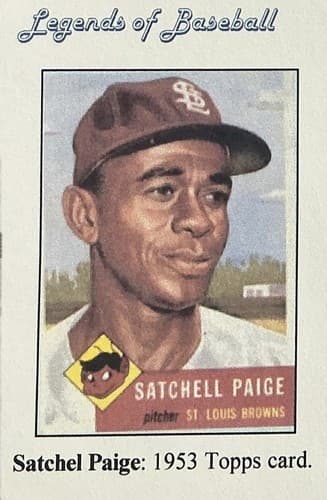
Satchel Paige was one of the greatest showmen ever to play baseball. He is also considered THE very best pitcher of them all by many fans. He played in the Negro Leagues and MLB. In July 1965 he pitched three innings against the Class A Spartanburg Phillies at Historic Duncan Park Stadium.
Satchel Paige Comes to Duncan Park
Satchel Paige was one of the greatest showmen ever to play baseball. He is also considered THE very best pitcher of them all by many fans. He played in the Negro Leagues and MLB. In July 1965 he pitched three innings against the Class A Spartanburg Phillies at Historic Duncan Park Stadium.
At 7:30 PM on Friday, July 16, 1965, 3,009 eager fans paid to watch a game at what was already "historic" Duncan Park Stadium in Spartanburg, South Carolina. This fact now seems both ironic and remarkable. Ironic because the Spartanburg Phillies, the home team at Duncan Park baseball stadium, finished the 1965 season 18 games behind the first-place Salisbury Astros in the single-A Western Carolinas League. The Phillies won 54 and lost 68, the team batting average of .230 was last in the 8-team league, and the pitching staff gave up more hits (1075) and fewer strikeouts (869) than any other team in the league.
Spartanburg Phillies attendance for the season and at the July 16th game, though, was also remarkable. In a stadium built for 2,500 fans, the team averaged a respectable 1,882 paying customers per game. This fact was due to the promotional genius of general manager Pat Williams, who had learned this part of his managerial craft from legendary Major League owner Bill Veeck, who once sent 3 feet, 7 inches tall Eddie Gaedel to bat for the St. Louis Browns, then pulled him for a pinch runner after he was walked by a clearly confused pitcher who couldn’t stay within Gaedel’s abnormally small strike zone.
Pat Williams’s lessons learned from “Wild Bill” Veeck paid big dividends. Not only did the Spartanburg Phillies win a Minor League Class A attendance award in 1966, but Williams himself was named Minor League Executive of the Year in 1967. So of course it was Williams who had the idea to bring the venerable pitching wizard Satchel Paige to the Hub City to throw three promotional innings during the Phillies’ game against Thomasville. Small wonder that more than 3,000 fans showed up on July 16th to watch him throw.
Satchel Paige was always cagy about admitting when he had been born, but in 1965 he would have been close to eligibility to collect Social Security. His reputation as a hurler had been firmly established many years before. His career had begun in the Negro Leagues, where he played for more than a dozen different teams—including the Birmingham Black Barons, the Pittsburgh Crawfords, the Kansas City Monarchs, the New York Black Yankees, and various All-Star teams—before the integration of Major League Baseball by Jackie Robinson in 1947.
In 1948 Satch was signed by Bill Veeck and finally brought up to play Major League Baseball for the Cleveland Indians, where he had a record of 6-1 and helped the Indians win both the American League and World Series titles. In Cleveland one of his teammates was Camden, South Carolina, native Larry Doby, the first Black man to play in the American League, who also played at Duncan Park Stadium for Jackie Robinson’s All-Stars. Other team members in Cleveland in 1948 included two 20-game winners—Bob Lemon and Gene Bearden—and a 19-game winner, master left-hander Bob Feller.
In the summer of 1965, after having appeared in both the 1952 and 1953 MLB All-Star games more than a decade before, Paige pitched three innings for the Kansas City A’s, becoming the oldest player ever to pitch in a major-league game. In all, old Satch pitched for 6 years in Major League Baseball, 17 in three different Negro major leagues, and untold years on barnstorming, exhibition, and “All-Star” teams.
In July of 1965 Satch’s popularity when he pitched in Spartanburg was such that the local papers published half a dozen stories about his appearance over the course of two weeks. Like Columbia native William Price Fox, who interviewed him for Holiday Magazine in the Twilight Zone Bowling Alley Bar and Grill in Kansas City that summer and marveled at “how a man could be over sixty and look around forty and move as if he were thirty,” each writer who wrote a piece about him in the Hub City was impressed.
The caption of a photograph of the living legend in the Spartanburg Herald showing Phillies general manager Pat Williams how to hold his equally legendary sidearm pitch called him an “ageless barnstormer.” Spartanburg Journal Sports Editor Ed McGrath admired his “[e]ternal optimism” and “unquenchable spirit.” McGrath then went on to call the veteran hurler “lovable, amiable, legendary” and “one of the greatest throwers who ever lived.” Assistant Sports Editor Melvin Long called him an "ageless baseball wonder” and reported his remark that “I figure I’ve worked more than any pitcher on earth.”
Satch’s performance at Duncan Park was impressive at first. Pitching for Thomasville against the Spartanburg Phillies in the first inning, he got the first batter to fly out to right field, then struck out the next two batters. Gerry Griffin, his second strikeout victim, whiffed “lunging across the plate in an unsuccessful attempt to get a piece of [one of Satch’s famous hesitation pitches.]”
In all, the veteran all-star struck out four opposing players, including future switch-hitting MLB pitcher Barry Lersch. Things began to unravel for the old-timer in the third inning though. The Phillies first hit was a hard double to right field by Pete Jones, a local amateur batting for the home team on this special occasion. Jones had offered Paige $10 if he could strike him out. Instead Paige had to pay him $50 and then forked out another $20 to two other players when they also stroked successful clouts.
The third inning hits initiated a rally which resulted in a 2-0 win for Spartanburg over the visitors and their old hand. The locals’ success seemed to justify their fans’ love for the team, an affection that existed in spite of their poor place in league standings. It also confirmed the observation by Jim Foster, the Herald’s sports editor, that “Spartanburg is the hottest li’l ol’ Class A baseball town in America.” This latter fact was validated by the season attendance record they broke in the week after Satchel Paige’s attendance.
The fans’ affection for the team was also reflected in Paige’s conclusion that Spartanburg was “his kind of town” according to Melvin Long. As Long reported, “The warm friendliness and the people’s love for baseball caused him to pass up two flights back to Kansas City in order to spend an extra 24 hours here.”
In his 1983 essay “Leroy ‘Satchel’ Paige” for his Peachtree Publishers book The Chitlin’ Strut & Other Madrigals, Bill Fox wrote, “Satchel Paige didn’t walk or talk or think or pitch like anyone. He was all alone. In his heyday, no one could touch him.” Almost twenty years after his heyday, the people of Spartanburg would have agreed.
[William Price Fox was one of the cleverest and funniest writers the South has ever produced. His most comprehensive—and entertaining—account of his week-long visit with Satchel Paige is Satchel Paige’s America (University of Alabama Press, 2005; also, Fire Ant Books, 2005; and The Internet Archive at archive.org). Although increasingly hard to find, used copies are still currently available at amazon.com and occasionally at used bookstores if you get lucky.]

Dr. Edwin C. Epps
Author
Dr. Edwin C. Epps is a retired educator with more than forty years' experience in public school classrooms... He is the author of Literary South Carolina (Hub City Press, 2004) and a proud member of Phi Beta Kappa who believes in the value of the humanities in a rapidly changing world.