The Past, Present, and Future of Duncan Park Stadium
The Past, Present, and Future of Duncan Park Stadium
Dr. Edwin C. Epps
September 23, 2026•11 min read•2 views
As I sit writing this after being out with my new dog in temps in the lower 90s, I am pausing not only to enjoy some cool, fresh water but also to look back, examine the present, and hope for the future of Duncan Park Stadium.
The Past, Present, and Future of Duncan Park Stadium
Dr. Edwin C. Epps•September 23, 2026•11 min read•2 views
As I sit writing this after being out with my new dog in temps in the lower 90s, I am pausing not only to enjoy some cool, fresh water but also to look back, examine the present, and hope for the future of Duncan Park Stadium.
Share:
The Past
As I sit writing this after being out with my new dog in temps in the lower 90s, I am pausing not only to enjoy some cool, fresh water but also to look back, examine the present, and hope for the future of Duncan Park Stadium.
First, the PAST. Most readers of this blog will know by now that we celebrated the official centennial of the opening of the ballpark on July 11, 1926. One hundred years ago, hundreds of local fans and a few “off from here” gathered together to watch the Spartanburg Spartans inaugurate their season before a crowd of 2,500 enthusiastic fans. Judge Kennesaw Mountain Landis, the Commissioner of Major League Baseball, attended the launch, as well as the Mayor of Macon, dozens of local officials, and ordinary fans young and old.
Our centennial celebration was a success of course. The ceremony on the infield grass attracted our Mayor; the City Manager and Assistant City Manager; the Director of Parks, Recreation, and Special Events; the Superintendent of the city school district, who himself had played ball in college and in Minor League Baseball; the Athletic Director of American Legion Post 28; several members of the Front Office of our Hub City Spartanburgers, a High Class A affiliate of the Texas Rangers who play in our 2-year-old Fifth Third Park downtown; a retired researcher from the Local History team at our Spartanburg County Public Library; a representative of our Hillcrest youth baseball organization; and no doubt others whom I have forgotten to mention here.
The commemoration was featured on local television channels WSPA-TV and WYFF-TV; Fox Radio station 98.3; the pages of The Greenville News, The Spartanburg Herald Journal, and The Post and Courier newspapers; the Big Screens at the Spartanburgers home field just off of West Main Street in the heart of our business district and also at Fluor Field, the home of the Greenville Drive just over half an hour away down I-85 South; in a wonderful multi-display exhibition at the Public Library; a special Negro Leagues exhibition for the afterschool reading program of the Episcopal Church of the Epiphany; new banners and display panels at Duncan Park itself; and elsewhere.
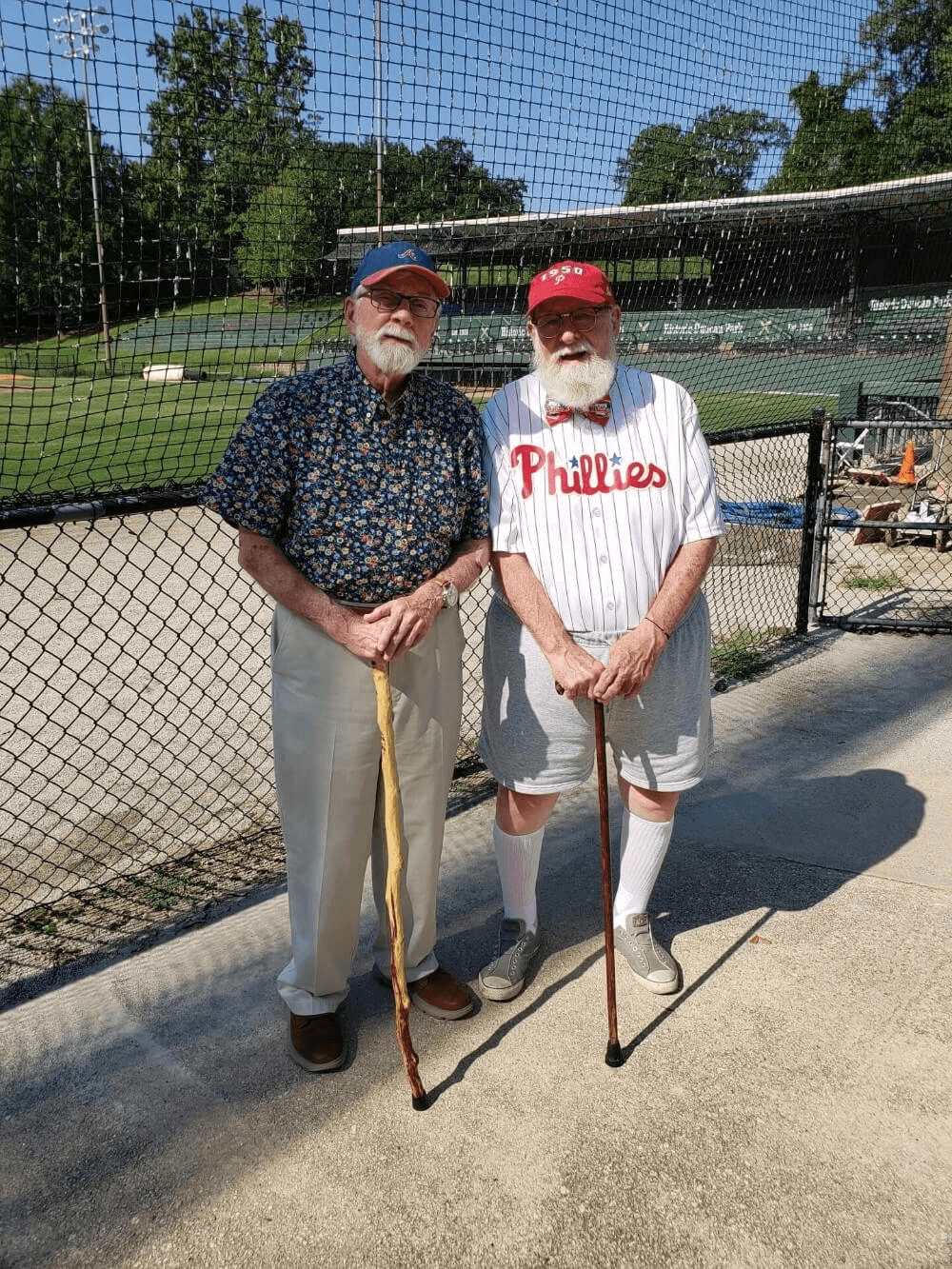
Proof that word about our historical milestone was getting notice elsewhere also came from an unexpected place: the environs of Philadelphia, Pennsylvania, where the Phillies MLB club have played for almost 150 years. Philadelphia is also the residence of a lifelong fan named Roy Cox, and Roy had discovered Duncan Park and its history via his interest in the Major League Phillies, who from 1963 until 1994 had a Class A Minor League affiliate which played at Duncan Park.
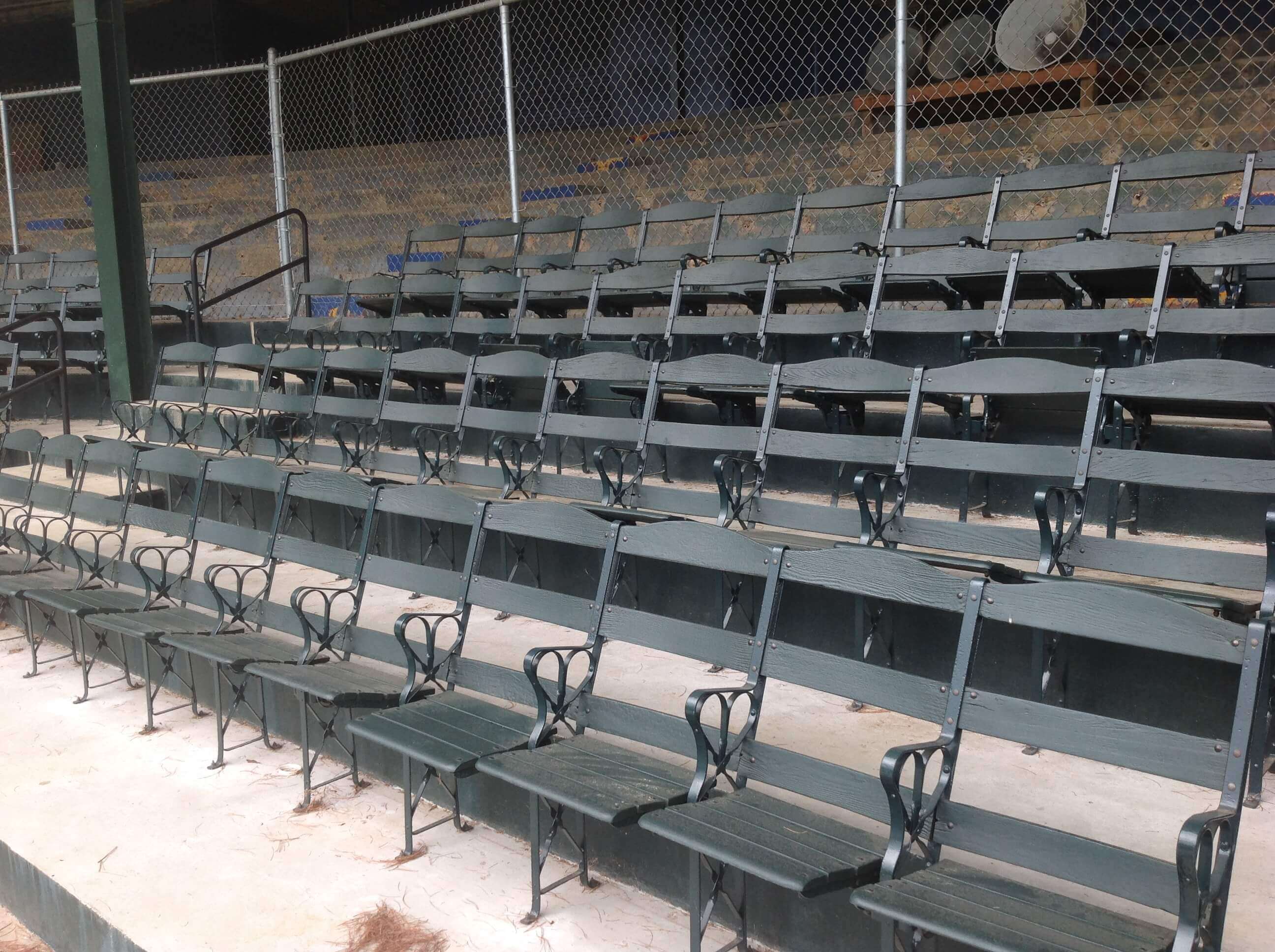
Roy Cox chatting with his new friend Luther Norman about the Negro League Spartanburg Sluggers who played for 50 years at Duncan Park. The green seats were a gift to the Spartanburg Phillies from the MLB team after the destruction of Shibe Park (later Connie Mack Stadium) in Philadelphia.
Painting of Sluggers star left-hander Bob Branson, known throughout the South as the Southern Satchel Paige
Two old guys at the ballpark
Roy was so interested in the history of Duncan Park that he decided he would like to come to Spartanburg to see it. He wanted the full treatment, though, so he made some preparations: He called Lauren Friedrich at the Spartanburg County Historical Association and Kim Brown at the City of Spartanburg and the staff of the Kennedy Room at our Public Library and the Front Office of our Spartanburgers. It wasn’t long before he had my telephone number too.
Roy and I talked and then I got to work. With the help of more people than I can name here we put together a schedule that included a personal tour of Duncan Park, two games at Fifth Third Park, lunch at Cribb’s Restaurant downtown (where, as Roy remembered, “A couple of local dignitaries stopped by to say hello”), a visit to the Kennedy Room, and an introduction to some of Luther’s Spartanburg Sluggers memorabilia. By the end of his time in the Hub City, Roy and I were both pretty tired.
Roy’s trip was a success. In a post-visit email from the City of Brotherly Love, he reported that he was “thoroughly impressed with what I saw in Spartanburg. Many thanks to all those that helped.” The self-proclaimed ambassador from the home of Ben Franklin returned to his own abode with a “suitcase… filled with mementos, and my mind was full of great memories.” So were the minds of his hosts here; a good time was had by all. Your author even learned a little about the Jersey Shore BlueClaws, Roy’s hometown MiLB team.
Roy’s BlueClaws lost to our Hub City Spartanburgers by a score of 4-11 in their game at Fifth Third Park during Roy’s visit on September 2nd.
The Present
A second recent instance of the attraction of the past of Duncan Park Stadium extended into the PRESENT occurred like this:
Not long before the Friends of Duncan Park’s adventure with Roy Cox I received an email from another friend asking if I’d be interested in talking to a group at the Summit Hills retirement community on the northeastern edge of the city. I wasn’t sure: a bunch of old people?! Then I realized that I myself am no spring chicken, so I cast aside my reservations.
Summit Hills is an active and engaged community, and among their educational programs over the past several months had been watching a series of South Carolina Educational television episodes from a series titled Carolina Stories. One of the programs was “Baseball in the Upstate,” but at the conclusion of this viewing, Summit Hills resident Rod Harley realized that there had been no coverage of Duncan Park Stadium, the historic old ballpark which is the very subject of this blog. Rod knew the seriousness of this omission, and he also knew about my book Duncan Park: Stories of a Classic American Ballpark (Hub City Press, 2023). The light bulb in Rod’s brain switched on: maybe he could get me to come to Summit Hills to right this wrong. Summit Hills has a Social Director and three Lifestyle Advisors, so Rod navigated the staff directory and secured the required approval, then called me.
I talk with various groups from time to time. In size they range from elementary and high school classrooms to individuals stopping to chat with me along the concourse at Fifth Third Park, from members of local Optimist Clubs to small audiences of donors and enthusiasts at Duncan Park itself, and from an auditorium full of patrons of our Public Library at my book launch in the Barrett Room in 2023 to individual visitors to my display table on the lawn at the entrance to Duncan Park on Park Drive and a class of Lifelong Learners at Wofford College. I was eager to chat with a diverse group of well educated individuals who had both a variety of life experiences and an obvious love of local history and baseball. I said yes to the Summit Hills invitation.
The occasion itself was relaxed, friendly, and inviting. Most residents of Summit Hills are native Spartans or at least Southerners although a few come from above the Mason-Dixon line or beyond the Mississippi. The University of South Carolina Upstate: Stomping Grounds of Dr. Olin Sansbury
Aside from Rod’s, another especially welcoming presence was Dr. Olin Sansbury, the Chancellor of USC Upstate when both my wife and I had positions, one full-time and one adjunct, at what used to be called “the branch” but what is an institution particularly skilled at meeting the needs of its student body and where most faculty gladly give more than their expected time and energy to their undergrads and graduate students alike. My senior audience patiently endured my 45-minute presentation and the Q & A session that followed it, but, more importantly, made me feel completely at home. There were some 40 attendees all together, and everyone was genuinely interested in what I had to say. A few shared their own memories of the old stadium with me after I spoke, and a couple actually bought copies of my book!
My reception at Summit Hills was yet another reminder of the continuing and present impact of baseball in Spartanburg, a strong argument for the Duncan Park facility’s preservation, maintenance, and renovation. More on this below.
The Future
One more indication of local and in fact national interest in the future of Duncan Park Stadium is two days away as I write this blog post. On Wednesday, September 23rd, the Friends of Duncan Park will sponsor an excursion to our fair city from Carrollton, Texas, near Dallas, by well-known Negro Leagues researcher, benefactor, and historical stadium consultant Dr. Layton Revel.
Spartanburg’s own Luther Norman and I have known Dr. Revel for a number of years as one of the most respected authorities in the country on Negro Leagues baseball as well as an experienced designer and consultant on the construction, utilization, and funding of historic stadiums and museums. He has worked with committees and boards at Rickwood Field and the Negro Southern League Museum in Birmingham and also multiple baseball facilities in Texas and Tennessee. He founded the Center for Negro League Baseball Research, and his work was influential in MLB’s decision to award pensions to former Negro League players. He has interviewed more than 1,500 former Negro League players, and his archival collection contains as many signed baseballs. Most of what is displayed at the Negro Southern League Museum is from his collection, and both MLB and SABR have depended upon and profited from his research.
Luther has known Dr. Revel for decades, and I have known him for a dozen years since early in my research process for my book. The Friends have talked with him in a conference call and also met him on ZOOM, but he and we both wanted to have a personal meeting as well, especially at Duncan Park. The doctor has wanted to see our stadium for a good while, and we wanted him to come to see us as we begin to plan seriously for its future. We were heartened back in 2006 when Lenny Mathis organized the original Friends and managed to forestall the wrecking ball, and we were all further encouraged by the Letter of Agreement between the City and School District Seven two years later. Even twenty years ago, though, we began looking for a long range plan and dependable ongoing funding via an endowment and grants.
Stable maintenance and funding have been problems for every old baseball stadium in the U.S., and it was clear that the best course for us was not to depend completely and forever upon the vagaries of income from taxation and bond issues. It was important that we try to find a way to make the facility as nearly as possible self-sufficient, particularly in terms of ongoing operations and also in order to generate funding for historical displays, preservation, and office/shop space to be able to have an on-site presence to accommodate visitors to our site and offer up some collectible merch.
The City and School District Seven agreed with the Friends that a visit by Dr. Revel would be a good thing, so we began the process. We met with others who had skin in this game: P. A. L. Spartanburg, the Spartanburg County Public Library, the Hub City Spartanburgers MiLB team, the Youth Sports Bureau, McMillan Pazdan Smith Architecture, and various audiences at civic clubs, churches, schools, and other institutions. It was a slow process, and medical interruptions of one kind and another played into our plans, but we finally assembled the folks we needed, a time to meet, a cool place to gather together (the conference room of Fifth Third Park), and the beginnings of an idea of what we wanted to do at this time and in this place.
A variety of local organizations advise the Friends of Duncan Park as it works to ensure the preservation of Duncan Park Stadium, its legacy, and its ongoing contributions to the communities which it serves.
The core of Dr. Revel’s visit with the Friends was the schedule for Thursday, September 24th. The day began with a tour of Duncan Park Stadium, facilitated by the City of Spartanburg Department of Parks, Recreation, and Special Events. This event was focused on concerns identified as primary by both the Friends and Dr. Revel, both of whom had prepared a list of topics for discussion in preliminary conversations. Following lunch the group assembled again, this time in the Conference room of the Hub City Spartanburgers. Planned as an extended roundtable workshop, this session lasted two hours with participants chosen by their organizations as particularly knowledgeable of the condition, contributions, and possibilities of the ballpark facility. The working dialogue was succeeded by a tour of the Spartanburgers stadium, a still new state-of-the-art facility which had demonstrated impressive success in design, attendance, promotions, fan appreciation and devotion, financial success, and community support during its first two years of existence.
Although there are obvious differences between a vintage ballpark that is one of the oldest in the nation and a spanking new gem of a facility boasting the best that modern engineering is capable of, the committee hoped that a comprehensive introduction to the innovative downtown structure would suggest potential steps to take with the grand old traditional stadium five minutes down the road.
The next post on the Beautiful Duncan Park blog will present the deliberations, analysis, and recommendations of this day-long process. Readers of this blog are invited to please feel free to comment with your own reactions and suggestions regarding the future of Duncan Park Stadium.
Dr. Edwin C. Epps
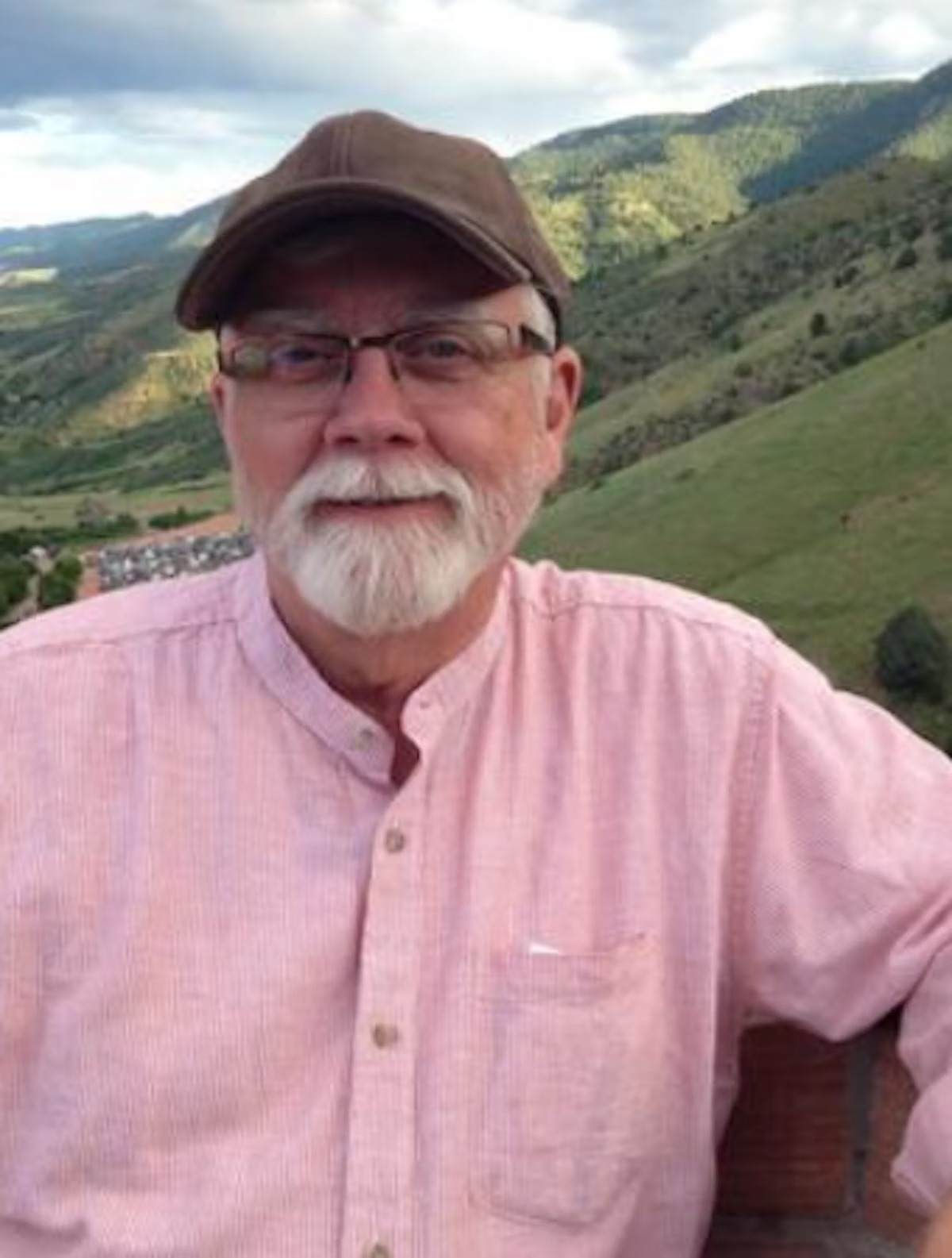
Author
Dr. Edwin C. Epps is a retired educator with more than forty years' experience in public school classrooms... He is the author of Literary South Carolina (Hub City Press, 2004) and a proud member of Phi Beta Kappa who believes in the value of the humanities in a rapidly changing world.
The day will begin at 9:00 AM with a Major League Baseball Play Ball clinic for area youth. An official commemoration of the Centennial will follow the clinic at 11:00 AM. Finally, to conclude the day the Spartanburg Peaches and the Greenwood Flying Monkeys of the summer collegiate wooden bat Blue Ridge League will play a regular season game at 1:00 PM.